
Australia’s population ticked over 28 million people two weeks ago.
It’s a moment that invites us to pause and reflect.
Not only on the scale of our growth, but on the direction of our nation.
Population growth has always been part of Australia’s story.
But today, it raises sharper questions.
Some argue that we are growing too quickly.
Others say we are not growing fast enough to defend ourselves in conflict or to sustain our economy, our workforce, and our living standards.
And some call for substantial cuts to migration, believing that will ease pressure on housing, infrastructure, or services.
But the real question, the one we must answer responsibly, is this:
What is the optimal level of population growth for Australia, and how can government shape it in a way that strengthens our economy, and improves living standards?
It is not an easy question.
But it is one we cannot avoid.
Focus on outcomes
Before we debate numbers, we must be clear about outcomes.
We want to improve living standards for Australians. We want each generation to pass on a better quality of life for their children.
We want businesses to remain profitable, productive, and able to generate secure jobs.
And we want an economy that grows sustainably — not in short bursts, but over decades.
To achieve this, government, particularly Treasury, must integrate demographic planning with economic planning.
That means setting realistic growth goals, consulting with business and industry, and aligning migration, skills, education, and housing policy so they work together rather than in silos.
What the data shows
The demographic data is unambiguous.
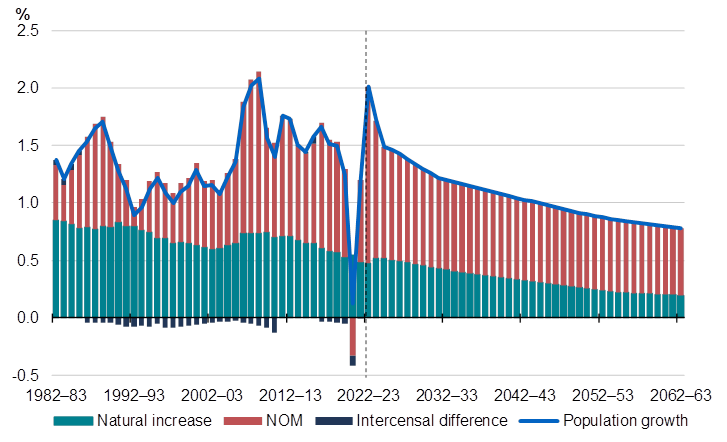
Australia’s population growth is projected to fall in the future.
Population Growth
Source: Intergenerational Report 2023
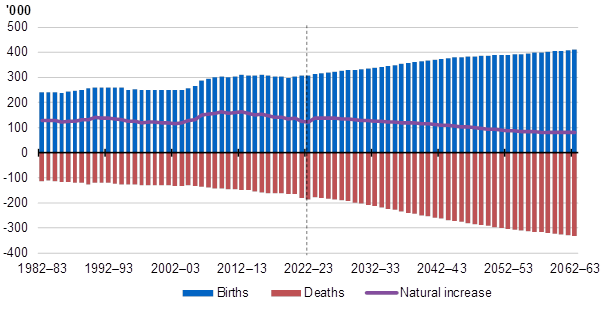
The rate of natural increase in the population is falling.
Australia’s natural increase and components
Source: Intergenerational Report 2023
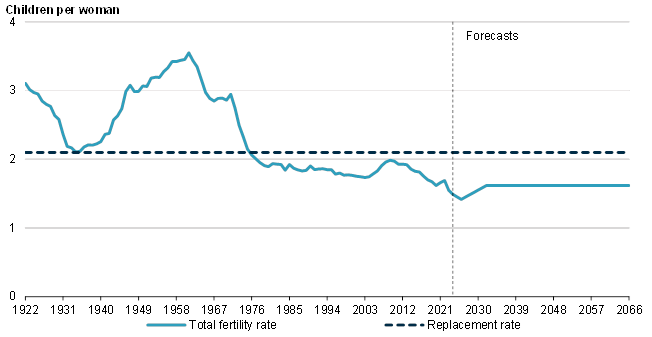
The fertility rate is falling.
Total Fertility Rate
Source: 2025 Population Statement, Centre for Population
And our population is ageing.
Between 1982–83 and 2022–23, the median age increased by 8.3 years to 38.5. During the same period, the share of the population aged 15 to 64 decreased by 1.0 percentage point to 64.7 per cent and the share of the population aged 65 and over increased by 7.2 percentage points to 17.2 per cent.
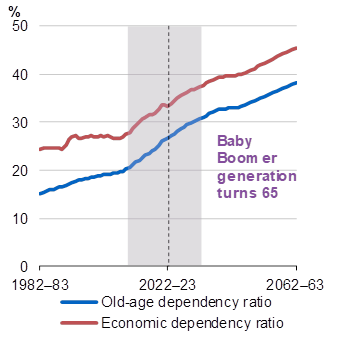
The old age dependency ratio measures the number of people aged 65 and over for every 100 people of traditional working age (15 to 64). Between 2022–23 and 2062–63, the old-age dependency ratio is expected to increase from 26.6 per cent to 38.2 per cent, reflecting the size of the population aged 65 and over growing faster than the working age population.
The old-age dependency ratio
Source: Intergenerational Report 2023
These charts on ageing point to a predictable shift: more retirees, fewer workers.
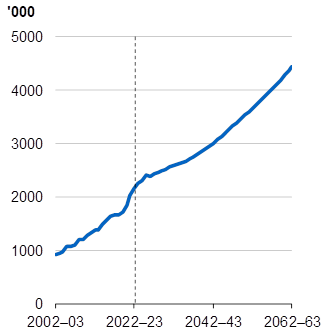
As a result, the number of workers required in Australia’s care sector to care for our ageing population is increasing and is expected to continue to increase dramatically.
Care employment
Source: Intergenerational Report 2023
And the working‑age population is forecast to shrink relative to demand.
This has profound economic consequences.
An ageing population means fewer workers supporting more retirees.
It means less income tax revenue.
It means higher spending on health, aged care, and disability services.
And it means skills shortages, not in isolated pockets, but across the economy.
We are already seeing shortages in healthcare, construction, engineering, and technology.
These shortages slow down projects, increase costs, and reduce productivity.
The VET sector is being reshaped to address these shortages, but the message from industry is consistent.
Without a stronger and more predictable supply of skilled workers, major projects will continue to face delays, costs will rise, and economic growth will be held back.
This aligns directly with Treasury’s demographic modelling.
An ageing population and a shrinking workforce mean Australia must plan for both domestic training and skilled migration if we want to maintain living standards and economic momentum.
What happens if we substantially cut migration?
Some argue that the solution to Australia’s housing crisis and cost of living pressures is to substantially cut migration.
But we must be honest about what that would mean.
As Australia’s permanent migration program is heavily focused on skilled migration a substantial cut to the current 185,000 number would likely lead to a reduction in the working age population in Australia, exacerbating skills shortages and worsening the old aged dependency ratio as well as the budget.
The Parliamentary Budget Office has costed the Liberal Party proposal to reduce the planning level for the permanent migration program from 185,000 to 140,000 over three years from July 2025.
They found that the proposal would be expected to decrease the underlying cash balance by around $3.4 billion over the 2025-26 budget forward estimates, reflecting decreased revenue from personal income tax receipts.
The conclusion is clear: substantially cutting migration when our population is ageing and our fertility rate is falling would reduce economic growth, shrink the labour force, and lower living standards over time.
If left unchecked, an ageing population combined with low migration can have long-term economic consequences.
The workforce contracts.
Domestic demand falls.
The economy struggles to maintain momentum.
Australia cannot afford to go down that path.
Planning for sustainable economic growth
To ensure we can meet our goal of better living standards for the next generation of Australians we need a sensible, measured approach to skills development and migration based on facts not fallacy.
The Albanese Labor Government has developed a plan to reduce skills shortage over the next decade.
The priority for skills development must be to train more Australians in the industries where skills are needed into the future.
The national economies that will thrive in the future will be those that have the skill base to support investment in innovation and emerging technology such as artificial intelligence and a net zero economy.
To meet this challenge investment in education and vocational training must be the priority, and it is for our government.
To facilitate this, we have invested an additional $2.5 billion in vocational and tertiary training through policies such as Fee-Free TAFE, funding 1400 additional university places in STEM based courses and introducing a practical placement payment of $319.50 per week for students required to take on practical placements as part of their course.
Importantly, we are planning the skills needs of the future through the creation of Jobs and Skills Australia - a tripartite body through which industry, unions and government work together to plan the skills requirements of the future so government policy is responsive to industry need to provide a springboard for growth into the future.
To ensure employers have the skilled labour they need Australia will also require a reasonable level of skilled migration based on the needs of Australian industry and the states and territories. For the past two years the planning level our government has set is 185,000 permanent migrants per year.
Remarkably when Labor was elected in 2022, we found that Australia did not have a plan for migration. The Parkinson Review found that our previous migration system was “broken”.
Regarding migration, Dr Parkinson said:
The objectives of the program are unclear, and successive governments and policymakers have responded to challenges through piecemeal reforms which have not addressed fundamental underlying issues.
We are determined to fix our migration system and ensure it works to benefit all Australians again.
We are achieving this by having a Migration Strategy for Australia with a clear set of goals and an action plan to achieve those goals.
We have reduced net overseas migration by 45%.
We have set reasonable permanent migration planning levels based on consultation with business and the states and territories.
We have prioritised skilled migration with incentives for working in rural and remote locations.
We have rebalanced student visa settings to improve integrity and encourage study in regional universities and training institutes.
We have established the National Innovation Visa to attract the world leading innovators to work in Australia.
We are improving skilled visa processing times, and we are tackling the backlogs that have eroded confidence in the migration system.
Australia needs a migration system that delivers the skills our economy relies on.
While shutting down the exploitation and loopholes that undermined confidence in the system for too long.
That is exactly what our Government is rebuilding.
A system based on integrity, skills, and national interest, not on rorts or neglect.
In contrast, some of the proposals put forward recently have been shaped more by political tactics than by economic reality.
They are designed to appeal to the loudest voices on the fringes, not to address the genuine workforce shortages facing employers across the country.
A targeted, skills - focused migration system
We need a migration system that is targeted, evidence‑based, and aligned with workforce needs.
That means: Prioritising skilled migrants in areas of genuine shortage.
Using transparent, data‑driven skills lists.
Ensuring concessions are available where critical shortages exist.
Working with States and Territories on housing, infrastructure, and service planning.
Economic reform and productivity
Population policy cannot stand alone.
It must be supported by broader economic reform.
We need a tax system that rewards productivity, supports families, and sustains the revenue base required for essential services.
We need investment in infrastructure, technology, and innovation.
And we need policies that lift participation, including for women, older Australians, and people with caring responsibilities.
Recent budget changes have begun this work, but more will be required as demographic pressures intensify.
Avoiding decline, securing the future
The central challenge is this:
How do we avoid reduced living standards and a shrinking economy as our population ages?
The answer lies in a balanced approach:
A strong, targeted skilled migration program.
Investment in education and training.
Economic reform that lifts productivity.
Planning that integrates housing, infrastructure, and workforce needs.
And a permanent migration program that supports long‑term nation‑building.
This is not about ideology.
It is about evidence.
It is about economic reality.
And it is about planning for the Australia our children will inherit.
Australia’s demographic challenge is not a crisis, but it is a turning point.
We can choose to retreat, to slow down. This is guaranteed to reduce Australians living standards and ensure we fail to hand on a better standard of living for our kids.
Or we can choose to plan, to grow, and to build a stronger, more resilient nation.
Migration, when well‑managed, is not a burden.
It is a driver of productivity.
And it is one of the most effective tools we have to meet the challenges of an ageing population.
If we get this right, we will secure a more prosperous, more dynamic, and more confident Australia.
Not just for today, but for decades to come.
Thank you.